
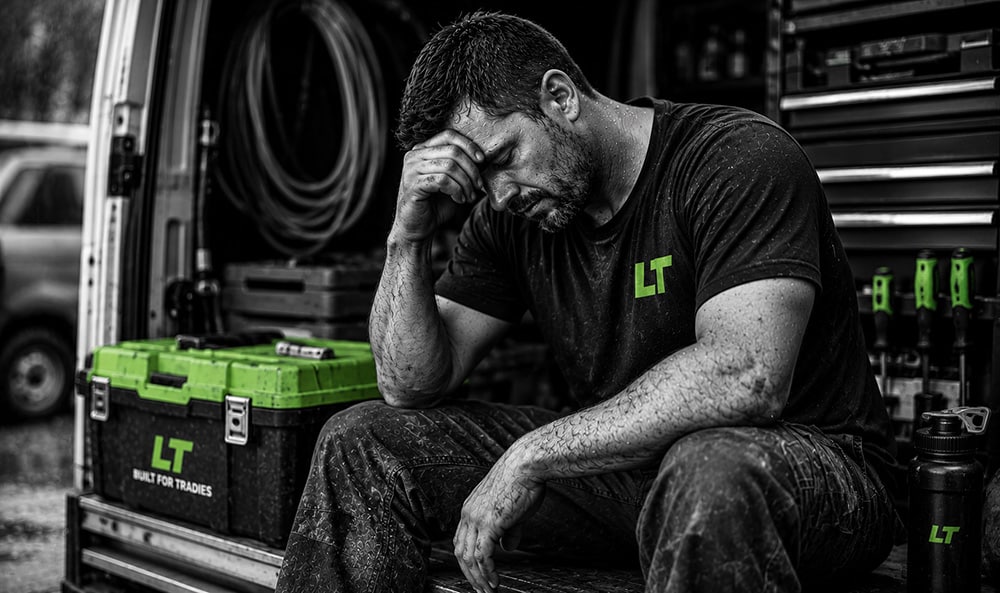
Where are you right now? On the tools? In the ute? Answering an email between jobs at 6pm on a Wednesday?
Be honest.
For most trade business owners, the answer to “why am I still on the tools?” starts with a version of the same list. I don’t have the right people. I can’t afford to hire. The lads can’t do it as well as I can. I’ve tried delegating and it fell over. There’s no time to train anyone. I need to stay across it because if I don’t, it goes to custard.
All of that might be true. None of it is the actual problem.
The actual problem is this: you were trained as a tradesman, not a business owner. The identity you built over your apprenticeship, and reinforced over every year since, is that you are the person who does the work. The best plumber. The fastest sparkie. The most reliable chippy on the crew. That identity was your competitive edge for a decade or more.
And now it’s the ceiling on your business.
Table of Contents
The three signals you’re stuck in the technician role
You’ll know you’re in the technician trap if these ring true:
1. You’re the bottleneck on every big decision. Quotes over a certain size can’t go out without your eyes on them. New team members have to be trained by you personally. When a difficult customer calls, the office puts them through to you. If you take a day off, the messages pile up.
2. You can’t take a proper holiday. A “holiday” for you means answering the phone from a beach. A real break, seven days off the grid, would leave the business in enough disarray that you’d rather not risk it. If you did take one, you’d come back to three inboxes worth of drama.
3. Every quote needs you. Nobody else in the business knows how you price. Nobody else has the mental model of what a “good job for us” looks like. You are the pricing engine, and until someone else can be, every dollar of new revenue has to move through your calendar.
If any of those sound like you, congratulations. You’ve correctly identified the problem. Now the question is what to do about it.
Why “I’ll get off the tools once I have time” never works
Most tradies think about getting off the tools as a scheduling problem. “Once I have time to train someone, once I have time to write it down, once I have time to hire, once I’m not so slammed.”
That day never arrives.
The reason it never arrives is that the thing keeping you on the tools is not your calendar. It’s your identity. Your calendar is a symptom.
While you still believe your value in the business is “being the best tradesman”, you will always find a way to stay in that role. You’ll take the tough jobs yourself because “the boys can’t handle it”. You’ll re-do the quotes your office manager wrote because “they’re not quite right”. You’ll knock back a productive planning day so you can get on site because “we’re short today”. Every one of those choices reinforces the identity. Every one of them locks you in tighter.
The way out isn’t to work more hours. It’s to change who you think you are inside the business.
The shift that changes everything
The shift, in one sentence: you are no longer the best tradesman in the business. You are the person who builds the business that has the best tradesmen.
That reframe sounds like semantics until you sit with it for a week.
The best tradesman on the crew is a role. It’s a specific technical job with specific outputs. It should be held by someone whose full-time job is to be excellent at that role. That person is not you anymore. If you’re the owner, and you’re doing that role, you are cost-shifting the highest-value work in the business (planning, pricing, hiring, leading, marketing, systemising) to the evenings and weekends. That is why you’re burnt out. That is why the business isn’t growing. That is why nothing changes.
The moment you accept that the “best tradesman” role belongs to someone else (even if that person doesn’t exist in your business yet), everything downstream gets easier. You stop competing with your team for the technical work. You start competing with yourself on the leadership work. You start hiring for the role you used to do, instead of hiring “help”. You start writing things down, because the business now needs to survive without your daily presence.
We talk about this shift as one of the four moves every trade business owner has to make. Read the full context in our cornerstone guide: How to Build a Rockstar Tradie Team (Without the Headaches).
What actually happens when you make it
The shift takes months, not weeks. But here’s what changes when you actually commit to it.
Your calendar reshapes. You start blocking time for the work only you can do (strategy, pricing decisions, hiring, key customer relationships) and stop letting operational fires eat those blocks.
You start hiring differently. Instead of “we need another pair of hands”, you start hiring for the role you’re vacating. That means you pay properly, you interview seriously, you onboard carefully, and you set the new person up to succeed rather than sink.
Your team lifts. A team without a clear leader defaults to the loudest voice in the room. A team with a clear leader defaults to the standard you set. The moment you stop being their peer on the tools and start being their leader, the whole team’s performance moves.
Your business stops being fragile. A business that runs on you gets sicker every time you get sicker. A business built on systems and a team keeps going when you don’t. That’s the difference between owning a business and owning a job.
And, over time, your income lifts. Trade business owners who successfully get off the tools consistently pay themselves more, not less. The best-run operators we coach have owner wages north of what a senior tradesperson would earn on wages elsewhere, plus profit distributions on top. But that only starts when you stop selling your own hands and start selling the capacity of a business.
For the honest, sometimes-uncomfortable version of what letting go actually feels like, have a listen to Hooked on Doing It All? How to Finally Let Go on The Tradie Show. If your excuse is genuinely “I’m too flat-out to think about this”, Stop the Chaos: How to Free Up Time and Finally Work ON Your Business and Time Thieves: The Invisible Profit Killer in Your Trade Business are the two episodes to queue up first.
Where to start this week
You don’t fix this in a weekend. But you can start this week.
Three moves for the next seven days:
- List the five things only you can do. Not “should”, not “prefer to”. Only you can do. Be brutal. Most tradies find their list is one or two items long, and everything else is habit.
- List the five things you’re doing that someone else on your team could do tomorrow if you handed them a two-page explainer. Pick one. Write the two pages. Hand it over. Watch what happens.
- Block two hours in your calendar next week for “owner work”. Not on the tools. Not in the ute. In the office (or the coffee shop) with a notepad and no phone. Use the two hours to think about who your next hire needs to be, not what job you need to quote next.
Three free tools that will help immediately:
- Time Maximiser. The guide we point new members to when the honest answer is “I’m drowning”.
- The Preloaded Year. Angela’s planning tool for locking the owner work into the calendar a year ahead.
- How to Be a Good Leader in Your Business. The leadership piece that has to move in parallel with the mindset shift.
One more thing worth naming. Delegating properly needs systems. If you’re going to hand work over to your team, you need “the way we do it here” to live outside your head. That’s the Platform pillar, and it pairs with this one closely. Systems for Tradies: The Backbone of a Business That Runs Without You is the cornerstone read.
Ready to design a business that doesn’t need you on the tools?
Inside Lifestyle Tradie, this is exactly the work we do with members week by week. The systems, the hiring, the leadership shift, the pricing decisions, the toolbox meeting rhythm, the KPI dashboards. Everything you’d need to stop being the bottleneck and start being the architect.
It’s the same work we did at Dr.DRiP that let us take real holidays, then eventually sell the business and walk away for real money.
If you’re ready to stop being the reason your business can’t grow, book a free 30-minute Strategy Call with the Lifestyle Tradie team. We’ll look at your current setup and tell you, plainly, what the next move is.
Or see what’s inside the membership: See what’s inside Lifestyle Tradie