
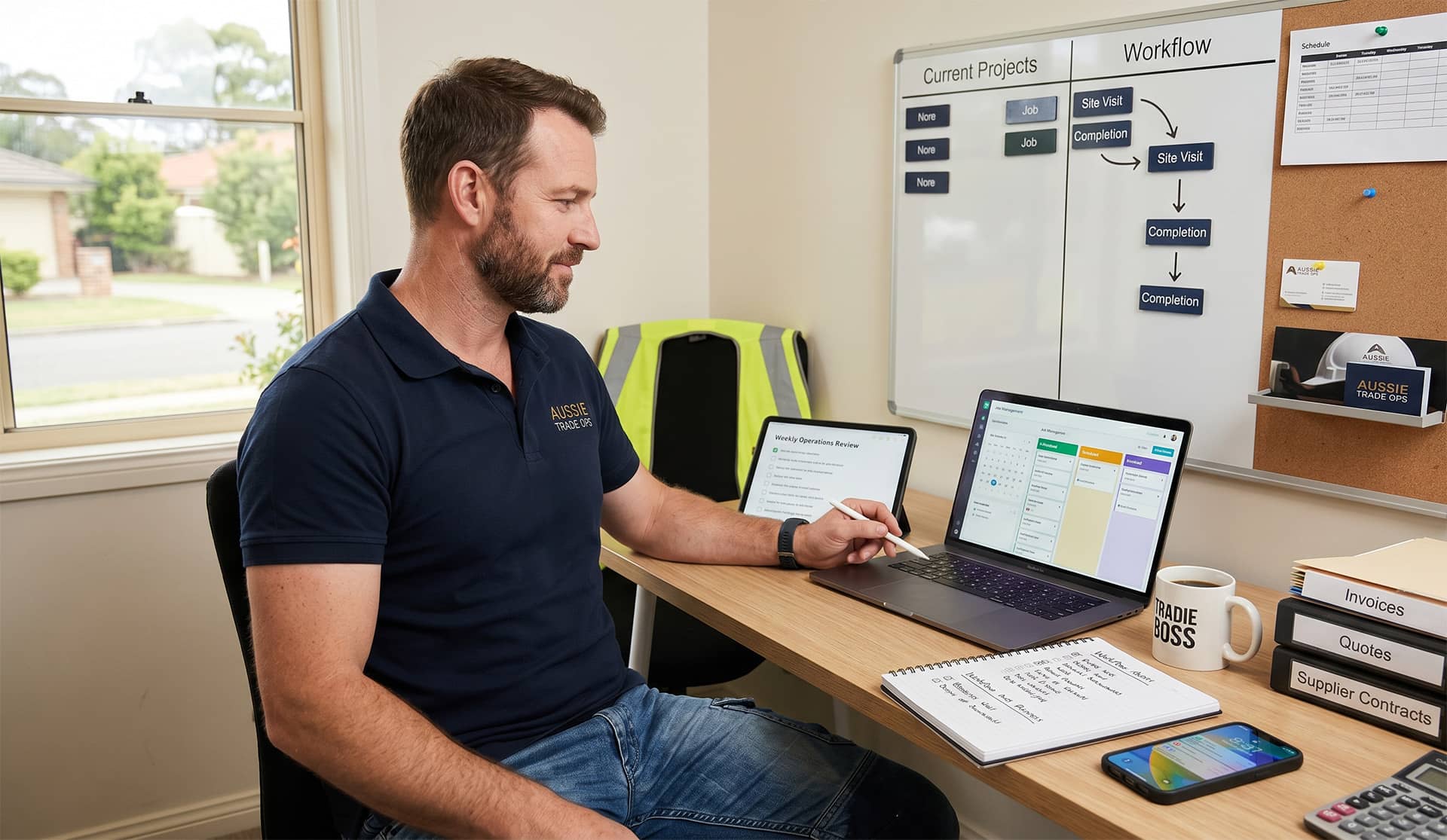
Quick question. If you got hit by a bus tomorrow, could your team run a full day of jobs without you?
Not a pretend day. A real one. Real customers. Real quotes going out. Real invoices. Real problems. Could the team actually carry on, or does everything stop until someone rings you in hospital to ask where the spare key is?
For most tradie owners, the honest answer is no. The business isn’t a business yet. It’s the boss, plus some help.
That’s what this guide is here to change.
We’re going to walk through the second of the 3 P’s to Freedom Formula: Platform. Put plainly, Platform is the backbone of your business. The job management software, the finance platform, the customer and team connectivity tools, the documented procedures, the vision and values, and (increasingly) the AI that runs on top of it all. Platform is what lets a trade business scale past $2M, sell for real money, or let the owner step right back.
We won’t hand you the templates. Those live inside Lifestyle Tradie and members work through them with us. But you’ll finish this piece knowing exactly what needs to be built, in what order, and why.
This is Pillar 2 of the 3 P’s. The other three hubs: People, Profit, and Marketing.
Table of Contents
Why most trade businesses cap out
Trade businesses cap out somewhere between $800K and $2M revenue, with surprising consistency. We’ve seen it a hundred times.
The reason is almost always the same. At that point, the owner is the system. They hold the customer knowledge in their head. They quote off gut feel. They dispatch by memory. They know where every job sits because they drove past it at lunchtime. Nothing is written down. Nothing is repeatable. Every problem escalates to the boss because the boss is the only person who knows what the business does.
At that size, two things happen. The business stops growing, because there aren’t enough hours in the owner’s week to grow it. And the owner burns out, because there aren’t enough hours in the owner’s week, full stop.
The way out isn’t working harder. It’s building a platform that works in your place.
For the podcast version of that shift, have a listen to Your ‘Systems Blueprint’: Less Chaos, More Control on The Tradie Show. Stick it on in the ute.
What “platform” actually means in a trade business
Don’t confuse Platform with a software subscription. That’s part of it. It isn’t all of it.
At Lifestyle Tradie we think about Platform as four buckets of infrastructure that every real trade business needs, plus two “softer” layers that sit underneath.
The four buckets:
- Job management. How jobs flow through the business from enquiry to invoice.
- Finance. How money is tracked, reported and paid.
- Customer and team connectivity. How everyone stays on the same page.
- Documented procedures. How “the way we do it here” lives outside your head.
The softer layers:
- Vision, mission and values. The strategic direction that tells the platform what to optimise for.
- Business structure. The legal and ownership wrapper that protects what you build.
Every one of those matters. Let’s walk through them. For the podcast version of the overview, see Take Your Business to a 10/10 With the Right Productivity Software on The Tradie Show.
Bucket 1: Job management
The single biggest leverage point in the first wave of system-building for a trade business is a real Job Management System (JMS). ServiceM8, AroFlo, simPRO, Tradify, Fergus. We’re not here to sell any of them. We’re here to tell you that without one, you are leaking money, time and customer trust every day.
A decent JMS captures the enquiry, schedules the job, tracks the tradesman in the field, captures signatures, sends the invoice, and talks to your accounting software. Done well, it collapses a full day of admin into a couple of taps on a phone.
Done badly, or not at all, it looks like paper dockets in the back of a ute, quotes re-keyed three times, invoices going out two weeks after the job, customers chasing you for paperwork, and tradesmen on the clock doing administrative work they hate.
There are five questions to answer before you pick a JMS. Team size. Job type (residential maintenance, commercial, projects, or a mix). Integration needs (accounting, payroll, inventory). Mobile-field reality (what the tradies on site actually have to do on their phones). And budget. Get clear on those five, then compare the big Australian players against them.
While we’re talking record-keeping, a quick reminder that the ATO requires Australian businesses to keep records that explain all transactions for five years. A proper JMS plus cloud accounting makes that painless. A shoebox of dockets and handwritten invoices does not.
Paired with a JMS is the decision to go paperless. Or at least paper-light. The time-back is real. Most tradies going paperless win back between four and seven hours a week once the new habits settle in. Inventory-heavy trades will also want our free Guide for Managing Your Stock to make sure you’re not paying for other people’s materials. The podcast companion is From Chaos to Cash: The Van Inventory Fix Every Tradie Needs, where Andy shares the Dr.DRiP story that saved $24K.
Bucket 2: The finance platform
If the JMS is the engine, the finance platform is the dashboard. And most tradies are driving blind.
A real finance platform in 2026 is three things working together:
- Cloud accounting. Almost always Xero. As the source of truth for your numbers.
- Connected inputs. Your JMS feeding in invoices, your bank feeding in transactions, a receipt-capture tool feeding in expenses, payroll feeding in wages.
- Dashboards and reports that the owner actually looks at every week.
Notice what’s not on that list. A shoebox of receipts, a bookkeeper who mails you a report every quarter, and an annual appointment with your accountant where you find out the bad news.
The finance platform is also where you set up the separate bank accounts that make Profit First work (we cover this in the Profit hub), where you track stock and inventory if that applies to your trade, and where your KPIs live.
If “my numbers are a mess” is the voice in your head right now, start with the Profit hub rather than the rest of this piece. You’ll know you need platform help, too, but you’ll know why.
Bucket 3: Customer and team connectivity
The third bucket is the one most tradies build last and regret leaving. It’s the connective tissue. The email, the signatures, the team chat, the CRM, the customer follow-up automations.
Customer connectivity is about making sure every customer experiences the same business, every time. Same tone in the email. Same professional email signature. Same follow-up after the job. Same reminder when the annual service is due. Done well, it stops you competing on price and starts you competing on experience.
Team connectivity is about making sure everyone on the team is on the same page. Scheduling, leave, toolbox talks, safety updates, the weekly numbers. Done well, the team runs itself.
The tools change every couple of years (right now: Gmail, Google Workspace or Microsoft 365 for the office layer; Slack, Teams or the JMS chat for the field; a light CRM inside the JMS for the customer layer). The tools matter less than the principle. One source of truth per conversation, visible to the right people, automated where it can be.
When customer connectivity meets the customer journey, you’re into marketing territory. The full four-stage approach (Attract, Convert, Deliver, Retain) lives in the Marketing hub.
Bucket 4: Documented procedures (SOPs)
Here’s the uncomfortable one.
If your business only works because you know how it works, you’ve got a job, not a business. Documented procedures, or standard operating procedures (SOPs), are how you move the knowledge out of your head and into the business. They’re the single biggest lever for turning a trade business into something sale-ready.
Every repeatable task in your business should eventually have a written, or filmed, or flow-charted version that any new hire could use to get the task done to the right standard without you hovering.
The three questions every SOP answers:
- What is the task?
- Why do we do it this way?
- What is the standard of a job well done?
At Dr.DRiP we eventually had a library of these. For the office, for the field, for onboarding, for complaint handling, for inventory. It was the backbone of the sale deal. Buyers don’t pay for turnover. They pay for a business that runs without the founder. SOPs are how you prove it.
A word on format. Don’t build a 200-page manual nobody reads. Short written steps, flowcharts where possible, and two-minute phone videos for the skill-heavy stuff beat a Word document every time.
If you want a head-start, grab our free Systems E-Book. It’s the how-to guide we point members to before they start building their own library. For the audio version, listen to Create Time, Reduce Errors & Scale Your Trade Business Using Systems with David Jenyns on The Tradie Show.
The softer platform: vision, values and structure
A trade business without a clear vision and a clear set of values is a trade business that drifts. Every decision becomes a fresh decision. Every hire is a coin flip. Every customer conflict is resolved from scratch.
Most tradies roll their eyes at “vision and values” content. We get it. It sounds like corporate theatre.
It isn’t. A real vision answers one question: “In three years, what does this business look like?”. Size, team, revenue, the kind of work you do, the kind of customer you serve, the hours you personally work. A real set of values answers a second question: “When we have to choose, what do we choose for?”. It tells you which customers to fire, which jobs to decline, which hires to let go.
Do that work properly and the rest of the platform falls into place. Skip it, and you’ll build systems that run a business you didn’t want.
For the planning and vision work, see The Key to Planning BIG HAIRY Goals for 2024 on The Tradie Show.
The other piece of the softer platform is business structure. Sole trader, partnership, company, trust. This is a conversation for your accountant, not a blog post. What matters at the platform level is that whatever structure you choose, it protects what you build, it’s tax-efficient, and it supports the long game (sale, succession, passive income). ASIC’s small-business registration and compliance guidance is a good starting reference, but get the accountant’s advice, make the call, then move on.
AI: the new accelerator
Three years ago, this section wouldn’t have been in this hub. Today it has to be.
AI, specifically the generative AI tools built on large language models like ChatGPT, is the biggest single productivity shift to hit trade businesses since cloud accounting. Used well, it’s an extra set of hands you don’t have to pay. Used badly, it’s a distraction that eats Sundays.
The short version on where to start. Start with the office side, not the field. Drafting job ads. Writing customer follow-up emails. Summarising training videos. Generating meeting notes. Answering simple customer FAQs. These are the quick wins. Autonomous dispatch and in-the-field diagnostics are coming, but they’re not the first things to touch.
The fastest way to get moving is our free guide, The Tradie’s Guide to AI & ChatGPT. Plain-English, no-jargon, written for tradies not tech bros. The audio companion is Turn ChatGPT Into Your Hardest-Working Employee (Who Works for Free) on The Tradie Show, plus What AI Agents Actually Mean for Your Trade Business for where this is heading next.
Cyber security: lock the platform down
Here’s a part of Platform most tradies never think about until it’s too late.
The Australian Cyber Security Centre (ACSC) reports small businesses as a rising target for cybercrime, and Scamwatch publishes regular warnings about the supplier-invoice scam that’s been quietly emptying Australian trade business bank accounts for years. The scam is simple. A hacker intercepts or spoofs an email, tells your admin person the supplier has new bank details, and the next large invoice gets paid into the scammer’s account.
One sparkie mate of ours lost $80K to exactly that scam. The money was gone by Monday, and the bank’s fraud team said what they always say: “we’ll try, but don’t expect it back.”
The four gaps most tradies need to close first. Supplier-payment scams (always verify new bank details by phone). Weak passwords (use a manager). Unsecured devices in utes (screen locks and remote wipe). Admin staff with full access to everything (principle of least privilege).
Our free guide Cyber Security for Tradies is a practical companion. The ACSC’s Essential Eight is the baseline every trade business should be working towards. You don’t have to do it all at once. You do have to start.
Spread your risk
The last three years have taught every Australian trade business that markets shift, economies wobble, and the only thing certain is change. Platform isn’t just about efficiency. It’s about resilience.
Spreading risk across customer types, job types, suppliers and revenue streams is what keeps a business standing through the tough years and springing through the good ones. Our free guide, Spread Risk in Your Trade Business, walks through the practical moves. The podcast version is Spread Risk in Your Trade Business and Survive ANYTHING! on The Tradie Show.
Sale-ready from day one
We want to close this hub on a point that surprises most tradies when we first make it.
The systems you build to run your business well are the same systems that make your business sellable. And the businesses that sell well are the businesses that were built sale-ready from day one. Not the businesses that were tidied up six months before a sale.
Think about it from the buyer’s side. A buyer is paying for three things:
- Documented systems. A business that runs without the founder.
- Recurring revenue. Customers who come back, not customers you have to re-win every job.
- A team that stays. A crew that will be there after the founder walks.
Every one of those is a platform decision. Every one of those is built over years, not months. Every one of those is also the thing that gives you freedom, long before sale, whether or not you ever sell.
The build-a-great-platform advice is identical whether you want to sell, scale, or just stop working Saturdays. That’s not an accident. The podcast companion here is You’ve Probably Never Considered Selling or Exiting Your Trade Business… Here’s Why You Should with succession expert Craig West.
What this looked like at Dr.DRiP
When we started, Dr.DRiP ran out of a diary and a filing cabinet. Quotes were written on carbon-copy books. Invoices were posted. Scheduling was done on a whiteboard Andy re-wrote every morning.
The first system was a basic job management tool. Then a cloud accounting switch. Then the paperless office. Then the SOP library. Then the separate Profit First bank accounts. Then the customer-connectivity automations. Then the team-connectivity layer. We didn’t do any of this in one bold week. We did it over six or seven years, adding one layer when the previous one was stable.
The compounding effect was enormous. By the time we sold, the business had a documented platform a buyer could step into. That’s what the sale price was built on. Not the turnover, not the brand, not the trucks. The platform.
Where to start
You don’t build a platform in a weekend. You build it one layer at a time.
A useful test: which bucket above made you most uncomfortable while reading?
If it’s job management, fix that first. Pick a JMS, commit, train the team, go paperless within ninety days.
If it’s finance, fix the accounting platform and the weekly-numbers rhythm before anything else. You can’t run a business you can’t see. The Profit hub is where you want to be.
If it’s connectivity, it means your customer or team experience is inconsistent. Start with the one that’s costing you the most right now. Usually customer. Head to the Marketing hub.
If it’s SOPs, pick one repeatable task (the most frustrating one) and document it this week. One a week for a year gets you 52 SOPs and a transformed business. Download the Systems E-Book to start.
If it’s vision and values, block out two hours with your business partner (or by yourself with a coffee) and write the three-year vision on one page. Every other decision gets easier afterwards.
If it’s the whole picture, grab The $1M+ Trade Business Playbook. 39 business secrets every Aussie tradie needs to know but wasn’t taught. It spans People, Platform, Profit and Marketing in one document.
The Platform library
Eight deeper guides on the Platform pillar are dropping over the coming months, each one building on a section of this hub:
- Why Tradies Hate Systems (And What Changes When You Build Them)
- Job Management Software for Tradies: How to Pick the Right Platform
- The Paperless Tradie: 7 Hours a Week You Can Win Back
- Standard Operating Procedures (SOPs) for Tradies: A Beginner’s Primer
- AI for Tradies: Where to Start Without Wasting a Sunday
- Vision, Mission, Values: Do They Actually Matter for a Trade Business?
- Cyber Security for Tradies: The Email Scam That Cost a Sparkie $80,000
- Selling Your Trade Business One Day? Why You Need to Start Now
A new guide drops roughly every two weeks. Jump on our weekly tradie business tips newsletter to catch them as they land, or book a Strategy Call if you want to skip the queue and work with us directly.
Want it on the tools rather than the screen? The Tradie Show podcast is the audio companion. Platform-pillar starting points: Your Systems Blueprint: Less Chaos, More Control, Take Your Business to a 10/10 With the Right Productivity Software, Turn ChatGPT Into Your Hardest-Working Employee, From Chaos to Cash: The Van Inventory Fix and You’ve Probably Never Considered Selling or Exiting Your Trade Business.
Ready to build the backbone?
Inside Lifestyle Tradie, members build out the entire platform with us, in the right order, with the templates, flowcharts, SOP library and implementation support we developed at Dr.DRiP.
It’s the same backbone we built into a business we sold. And it’s the backbone hundreds of trade business owners across Australia are building into theirs right now.
If your business still runs on you (your memory, your effort, your phone), it’s time to change that. Book a free 30-minute Strategy Call with the Lifestyle Tradie team. We’ll look at your four buckets, tell you where the weakest link is, and tell you where to start.
Book your free Strategy Call →
Want to learn more about how Lifestyle Tradie helps Australian trade business owners build more systemised, scalable businesses?
Learn more about Trade Business Coaching →
Or see what’s inside the membership: See what’s inside Lifestyle Tradie →